
Share Flora-Lee Wray's obituary with others.
Invite friends and family to read the obituary and add memories.
Stay updated
We'll notify you when service details or new memories are added.
You're now following this obituary
We'll email you when there are updates.
Select your format and elements to print

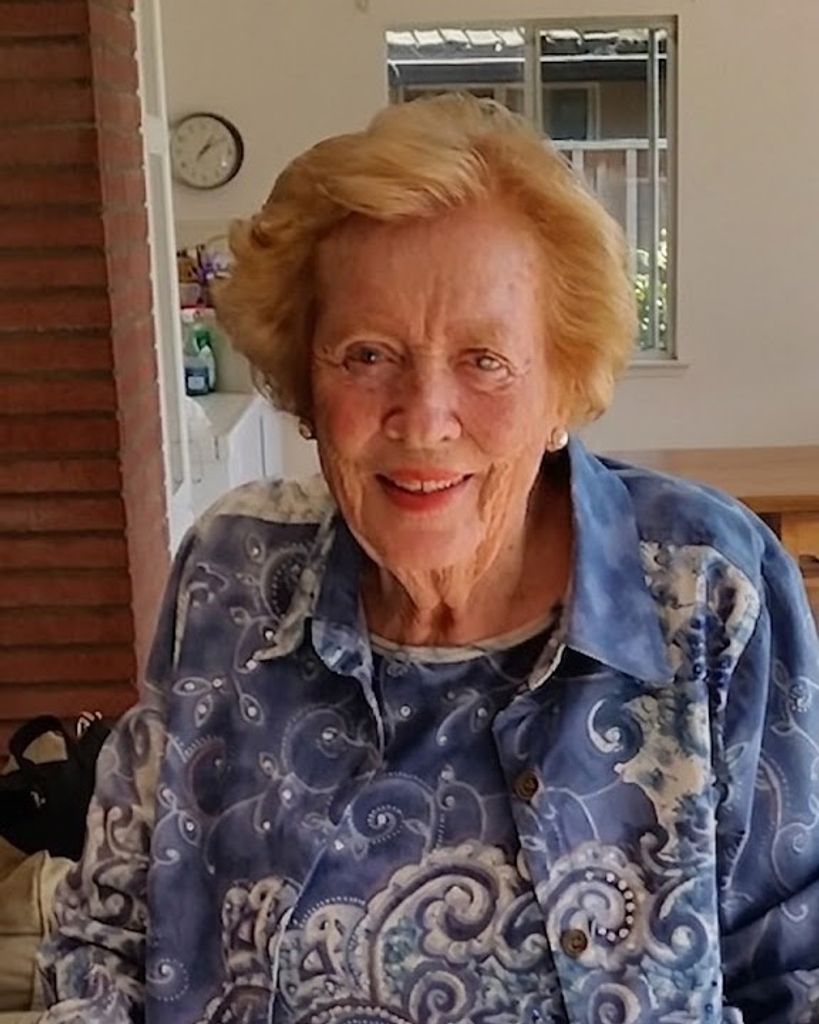


Flora-Lee Wray
May 24, 1927 — Jul 13, 2026
San Clemente
Flora-Lee Wray, an open and curious spirit with a sharp memory and a generous heart, died peacefully July 13, 2026, after a brief illness. She was 99.
If we could ask Flora-Lee now, she would say her life was “wonderful.” Alongside Karl, her foil and her soul’s counterpart, she built a life in San Clemente, pursued professional passions, and made innumerable friends. They didn’t “raise” their five children so much as show them a way of living. Together Karl and Flora earnestly and honestly dealt with everyone, no matter their politics or beliefs, and embarked on ambitious trips with less than minimum planning. They sought out art in every form, and invested in their community, by campaigning and fundraising for schools, parks and neighborhood beautification.
The birth of Flora-Lee Koepp on May 24, 1927, made page 3 of the next day’s edition of the Carmel (Calif.) Cymbal. Her parents, Guy Koepp and Zahrah (Lee) Koepp, eventually had four children, whom they raised in Carmel during the Depression. Flora’s siblings – Laura-Lee, Don, and Francie – only ever called her Pinky, for her fair skin. In the evenings during time designated for homework, they would take turns sneaking into the room that held the radio, listen in on the latest serials, then run back and share the stories with each other.
To go to Carmel is to know Flora-Lee. Its landscapes are beautiful, mystical even – and from there she carried with her a lifelong kinship with trees and forests. At the outset of World War II, the Koepp family joined relatives in Hollywood, Calif., where Flora-Lee would graduate from Hollywood High School. Though she lived on Curson Avenue just off the Sunset Strip and had multiple family members in the performing arts, Flora followed in the footsteps of her grandmother, Marie Nelson Lee, by pursuing a journalism career.
At the University of Southern California in the late 1940s, she joked that the setting was primed for young women to catch a “worldly” GI husband, but instead of having a wild dating life, she stood by her sorority house door in the evenings to let in her sisters who stayed out past curfew.
Putting others first would be a lifelong commitment for her. Indeed, she put her college ambitions on hold once she met an older GI of her own. She was lacking only a few classes to complete her journalism degree when she took a summer reporting job for the Lompoc (Calif.) Record. The newspaper’s owners, Ken and Harriet Adam, slyly moved her desk to face advertising sales manager Karl Wray. Two years later they were married. They would name one of their sons Kenneth.
Karl and Flora-Lee followed their newspaper dreams to San Clemente, where they would run the daily Sun-Post for about 13 years. Karl managed the business side and wrote everything from arts reviews to the Sunwrays column about the family’s life. Flora (who did eventually go back and finish up that journalism degree in the late ’60s) took on a variety of tasks, including proof-reading the legal announcements alongside her daughter, Diana. But her primary role was as society editor.
In the 1950s and 1960s, every happening in town was recorded in the society section. Flora-Lee was responsible for a full page once a week. The community shared with her their milestones, their joys and their hardships. She was uncompromising about getting names spelled correctly. Though she knew everyone’s stories, Flora was not someone you would ever call a gossip. She played it straight and never traded salacious tidbits.
Indeed, she was earnestly and genuinely curious about others. She was gently teased by her family for being loquacious, but the truth is that she listened carefully. She went out of her way to connect with people, and afterward she could tell you where they were from, who they were married to, and what their birthday was. There is no way you can have all of that information unless you ask questions and are sincerely interested in people. For her, there was no difference if you were the governor of California (one of whom she did know) or a random stranger sitting next to her on a train platform – she found the conversation fascinating. In her later years, when she couldn’t walk well and her grandson Nathan would drive her around town to do errands, it was important to her to get out (slowly) at every shop, so she could spend time greeting the bank teller, the chocolate maker, the post office worker. She knew, by name, everyone who worked at the Ralph’s on El Camino Real, where she was a champion coupon-shopper.
Flora-Lee is why, for decades, people gravitated to the Wray home on South Ola Vista. The classic mid-century house was designed by Flora’s architect father in the early 1950s, and the cozy kitchen and dining room took heavy traffic not just from the Wray kids, but all their friends, and their friends’ friends. Flora-Lee also took up with the neighborhood mothers: Mary Domenichini, Claire Manning, and Janet Carson among them. Flora had a leadership role in five different community groups at once, including a symphony guild she created with her friends.
The Wray home was a place that all were welcome, at all times, on absolutely zero notice. The door was never locked, and rarely even closed. Flora didn’t bat an eye at rough-and-tumble packs of kids roaming the place. Her feeling was that the carpets and the furniture were not important; what was important was what you did and saw that day.
While firmly planted in the San Clemente community, Karl and Flora also felt the pull of the big wide world. They famously drove, on their own, behind the Iron Curtain to visit relatives in what is now the Czech Republic. As members of professional newspaper associations, they often traveled for conferences, and found a way to use their press passes to see every ballet or theater performance nearby. (It was on such a trip that they happened to meet a gravelly voiced singer in a San Francisco coffeehouse, and years later, Flora would casually mention what a nice Texas girl Janis Joplin was.)
Although on a tight budget, the family traveled often. They frequently camped in state and national parks, which Karl and Flora revered; other times the trips were outrageously ambitious. The family walked through Haight-Ashbury in 1969 and adventured all over Hawaii in 1970. The most epic was the road trip to Panama. Youngest child Thomas saw 43 U.S. states from the back of a station wagon.
To make such trips possible with a large family and a non-existent budget requires a special brand of positivity and patience. This was Flora-Lee’s hallmark. Some attribute this to her spiritual practice, with an organization now known as the Center for Spiritual Living, whose founder guided believers to “take the good wherever we find it.” If you tried to bring up a sore subject, she would politely pretend not to hear you, and she deftly avoided sharing bad news. She was generous to a fault, and would share with anyone, even when resources were meager (and she had no concept of finance or paying bills anyway). She didn’t lecture, curse, or proselytize, and couldn’t be confrontational, even when it was called for. She wouldn’t fuss over petty things. She faced challenges with remarkable resilience and was genuinely always looking at the bright side.
But she was no saint. She could hold a mild grudge. She wouldn’t watch Clint Eastwood movies (too violent), and she refused to join the DAR (too snobbish). She detested the city of Irvine because it was too contrived and perfect, and insisted: “A city without a ‘bad’ section is a city without a soul.”
In her golden years, nothing seemed to give her more joy than her grandchildren and great-grandchildren (and their friends, and their friends’ friends), who she referred to as angels: “Good morning, cherubs.” She had a glorious vegetable garden (until Garciela the pig showed up, but that’s another story), and she would spend quiet moments in the morning harvesting fresh food for the household. She loved hosting, and wouldn’t let her guests help clean up. She indulged her grandchildren Penny and Ariel’s ideas for wild theme parties, happy to have her living room turned into a haunted house or a pirate ship. She took piano lessons and cherished music (especially the riffs played by her grandson Joshua on the guitar). She taught her granddaughter Molly the ritual of setting a beautiful table with tapered candles, though her cooking skills did not match the ambiance – but don’t sleep on her cheese toast. When still able to travel, she loved visiting her twin sons, Mark in Nevada and Kenneth in New York, where she could spend time with their families and get out into the wilderness nearby. She also made it back to beautiful Carmel several times. When the opportunity presented, she was known to hug trees.
Late in her life, she stayed close to home, and presided over family parties from her seat at the dining room table, where she also read the full Los Angeles Times every day, well into her 90s. She had beautiful handwriting and took pages of notes on her research into the family tree. She loved sharing these family stories with her son Norman, a fellow history buff. Her memory stayed sharp enough to remember the Chinese she learned in college – and speak it with her acupuncturist. She welcomed her sister Laura-Lee as a roommate for the last few years of her life, and they were devotedly attended to by Flora’s granddaughter, Janna. It was at this time that she started to let others cook the meals and clean the kitchen for her. But she still had a sense of adventure and a joy for discovery. When Janna took her out for appointments, Flora often wanted to take the scenic route home. Her curiosity about the world never left her.
Flora-Lee is survived by her sons Mark Wray (Lori), Kenneth Wray (Lynn Moffat), Norman Wray (Dani), and Thomas Wray (Terry), and 16 grandchildren and 13 great-grandchildren. She was preceded in death by her siblings, her husband, Karl, and her daughter, Diana Savage
Guestbook
Visits: 73
This site is protected by reCAPTCHA and the
Google Privacy Policy and Terms of Service apply.
Service map data © OpenStreetMap contributors